|

|
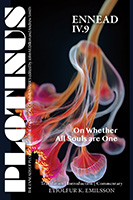
PLOTINUS Ennead IV.9
On Whether All Souls are One
Translation, with an Introduction, and Commentary
THE ENNEADS OF PLOTINUS
—WITH PHILOSOPHICAL COMMENTARIES
Series Edited by John M. Dillon and Andrew Smith
September 2026
979-8-988320-14-2
96 pages • 5 x 7.5 • Paperback
$32.00
|
|
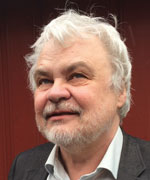 Eyjólfur K. Emilsson is Professor Emeritus of Philosophy at the University of Oslo, Norway. He received his Ph.D. from Princeton University in 1984 with a dissertation on Plotinus. He is the author of Plotinus on Sense-Perception (Cambridge University Press, 1988), Plotinus on Intellect (Oxford University Press, 2007), [with Steven K. Strange] Plotinus: Ennead VI.4 and VI.5: On the Presence of Being, One and the Same, Everywhere as a Whole (Parmenides Publishing, 2015) and Plotinus (The Routledge Philosophers series, 2017, 2nd edition, 2025). He is the translator of many Platonic dialogues and of other ancient philosophical works, mainly into Icelandic, but also into Norwegian and English. Eyjólfur K. Emilsson is Professor Emeritus of Philosophy at the University of Oslo, Norway. He received his Ph.D. from Princeton University in 1984 with a dissertation on Plotinus. He is the author of Plotinus on Sense-Perception (Cambridge University Press, 1988), Plotinus on Intellect (Oxford University Press, 2007), [with Steven K. Strange] Plotinus: Ennead VI.4 and VI.5: On the Presence of Being, One and the Same, Everywhere as a Whole (Parmenides Publishing, 2015) and Plotinus (The Routledge Philosophers series, 2017, 2nd edition, 2025). He is the translator of many Platonic dialogues and of other ancient philosophical works, mainly into Icelandic, but also into Norwegian and English.
|
|
|
|
This short, early treatise undertakes to explain the controversial thesis that all souls—this includes individual human souls and the world-soul—are in some sense just one soul. Plotinus considers a number of objections that can be raised against the thesis. For instance, if the thesis is true, it may seem to follow that that everything that holds for one soul also holds for every other soul.
Plotinus seeks to explain that such objections are off the mark, which also shows that the thesis about the unity of soul is not a claim about strict identity of all souls. He then (chapter 5) considers and rejects two materialistic hypotheses about the relationship between individual souls and the world-soul.
In the final chapter he presents his own solution: the individual souls and the world-soul are all the soul hypostasis. He likens the relationship between the hypostatic soul and the individual souls with that between a science and the theorems of the science: each theorem potentially contains the whole science and can in a sense be said to be it.
Plotinus was a Platonist, committed to expounding the doctrines put forward by Plato some seven centuries earlier. He was born and educated in Egypt, where he studied the teachings of Plato under the guidance of Ammonius Saccas. He came to Rome in 244 CE and built up a circle of followers devoted to studying Plato through Plato's own works and those of philosophers, both Platonist and non-Platonist, of the intervening centuries. From his fiftieth year Plotinus himself wrote down, in Greek, the findings of the seminars, and these writings were later edited by one of his pupils, Porphyry, and published in six groups of nine treatises entitled the Enneads (from the Greek word for nine – ennea). |
|
"Emilsson, whose books have so much furthered our understanding of the thought of Plotinus, has now given us a full commentary on Plotinus’ early and difficult treatise “On Whether All Souls are One.”
Plotinus here maintains that despite their undeniable individuality, all souls are ultimately one and the same soul. Emilsson’s lucid introduction and commentary succeed in showing how this apparent
paradox makes excellent sense. Much attention is paid to the so-called “science analogy” which is an indirect answer to the question what the all-encompassing soul is and how within itself it reconciles
unity and plurality. Emilsson shows how the structure of science or knowledge gives insight into the structure of soul and, beyond it, of Intellect because science, or knowledge, is not a system of abstract propositions but the crucial activity that characterizes soul and is rooted in Intellect itself.
The introduction focuses on the line of argument and the logic of the treatise and gives the background in Plato, Aristotle and Plotinus himself; the commentary adds information on particular points and tackles difficulties. There is a beautiful page on the geometrical method presupposed in Plotinus’ characterization of science.
The work can be recommended to everyone who wants to read Ennead IV.9 in the framework of Plotinus’ thought and to understand how paradox works in Plotinian philosophical argument.” |
—Christian Tornau
Professor of Classical Philology
University of Würzburg |
|
|
|
|
|