|
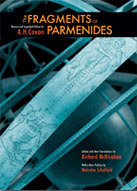
This book is a revised and expanded version of A.H. Coxon's full critical edition of the extant remains of Parmenides of Elea—the fifth-century B.C. philosopher by many considered "one of the greatest and most astonishing thinkers of all times." (Karl Popper) Coxon's presentation of the complete ancient evidence for Parmenides and his comprehensive examination of the fragments, unsurpassed to this day, have proven invaluable to our understanding of the Eleatic since the book's first publication in 1986. This edition, edited by Richard McKirahan and with a new preface by Malcolm Schofield, is released on the 100th anniversary of Coxon's birth.
This new edition for the first time includes English translations of the testimonia and of any Ancient Greek throughout the book, as well as an English/Greek glossary by Richard McKirahan, and revisions by the late author himself. The text consists of Coxon's collations of the relevant folios of manuscripts of Sextus Empiricus, Proclus and Simplicius and includes all extant fragments, a commentary, the testimonia, a complete list of sources, linguistic parallels from both earlier and later authors, and the fullest critical apparatus that has appeared since Diels’ Poetarum Philosophorum Fragmenta (1901). The collection of testimonia includes the philosophical discussions of Parmenides by Plato, Aristotle and the Neoplatonists, most of which had been omitted by Diels. The introduction discusses the history of the text, the language and form of the poem, Parmenides’ use and understanding of the verb ‘to be’, his place in the history of earlier and later philosophy and the biographical tradition. In the commentary Coxon deals in detail with both the language and the subject matter of the poem and pays full attention to Parmenides’ account of the physical world. The appendix relates later Eleatic arguments to those of Parmenides.

|
|
ForeWord Magazine Book of the Year Award
- Gold in "Philosophy"
Click here
|
|
 |
"If Coxon's text of the Parmenidean fragments cannot be regarded as definitive, his edition has nevertheless contributed more to a better understanding of the text than virtually any other work in the last half century. Now that most of his proposed alterations have been digested by the scholarly community, the continuing utility of his edition resides primarily in the wealth of comparanda and testimonia it provides. All students of Presocratic philosophy should be grateful that Richard McKirahan and Parmenides Publishing have done such a fine job in making once again available this seminal resource and in updating it with some of the continued musings of one of Parmenides' most singular devotées."
(read the full article here) |
—John Palmer
C.H.Beck Journals
Gainesville/Florida |
|
 |
Parmenides Publishing deserves full praise for producing this revised and expanded edition of A. H. Coxon's 1986 edition of the fragments of Parmenides. Many with an interest in Parmenides, perhaps the most difficult of all the Presocratics, will already be aware of the value and depth of Coxon0.s original treatment. This new edition is released on the hundredth anniversary of Coxon's birth. Edited by Richard McKirahan, it includes a typically acute foreword by Malcolm Schofield, who notes both the authority and indispensability of the first edition and the real need for a sec ond. The 1986 edition has long been out of print and such is its success that I have, in the past, witnessed a desperate scramble for the 'phone provoked by rumours of a volume for sale. Much as I find it thrilling to see books on ancient philosophers move at such a lightning pace, it is undoubtedly preferable that Coxon's scholarship is once more available to all.
(read the full article here) |
—Jenny Bryan
University College London |
|
The name of Parmenides of Elea, the eminent Greek philosopher of the fifth century B. C. E., may only be familiar to readers of Plato’s eponymous dialogue and students of Pre-Socratic philosophy. A quick glance at Parmenides’s remaining fragments, which are in verse, reveal a densely cryptic mind, which is not made much clearer by the quotations from him which can be found scattered around the works of later philosophers. Moreover, Parmenides’s writings sometimes border on the mystical, and one may be forgiven for wondering whether it is even possible to conjecture accurately from a series of fragments and quotations in other authors what he thought, or even to make a coherent translation of Parmenides’s rather arcane, quasi-religious language. In the end, the answer to the latter question is a resounding “yes,”...
(read the full article here) |
—Dr. John Butler, editor
'the Quint' Humanities Journal |
|
After the republication in 2008 of Mourelatos, The Route of Parmenides (1970) – revised by the author himself – “Parmenides Publishing” has given a new generation of scholars and students Coxon’s edition of the fragments of Parmenides. The new version of this book that, after H. Diels’ Parmenides Lehrgedicht (1897), imposed itself as the “classical” edition of Parmenides’ text, was revised by Richard McKirahan, a scholar who has extensively worked on Presocratics.
(read the full article here or here) |
—Sofia Ranzato
www.syzetesis.it |
|
| "A.H. Coxon's Parmenidean Fragments is a monumental work of scholarship, a deeply reflective and erudite contribution to the study of Parmenides, of other Eleatic philosophers, and of Presocratic thought in general. It is also of major significance for our understanding of a wider range of Greek literary and philosophical texts, from the poems of Homer onwards. No future students of this literature can afford to ignore it." |
—David Gallop
Professor of Philosophy Emeritus
Trent University |
|
| "Coxon's essential edition, the fruit of a lifetime's reflection, marked a major advance in our understanding of Parmenides' language and thought when first published in 1986. This significantly expanded edition includes translations by Richard McKirahan of the ample stock of testimonia assembled by Coxon, thus making an already vital resource even more useful for all students and scholars of early Greek philosophy." |
—John Palmer
Professor of Philosophy, University of Florida |
|
| "The unrivaled achievement of Coxon’s The Fragments of Parmenides of 1986 appears here in a new guise. While the book retains all its usefulness to Greek scholars and ancient philosophers alike, the reader of this new edition must thank Richard McKirahan both for a meticulous edition and incorporation of Coxon’s own subsequent comments on his text and also for English translations of all the Greek words and phrases in the Introduction and Commentary and of the sixty pages of Greek (and Latin) Testimonia. This self-effacing effort makes the results of Coxon’s unique scholarship available to 21st century students of Presocratic philosophy and to any modern philosopher who has an interest in the origins of the discipline. The book is much more than a useful tool for the study of Parmenides, it is the corner-stone on which future interpretations of the Eleatic will be built." |
— Fritz-Gregor Herrmann
Reader in Ancient Philosophy and Literature
Swansea University |
|
| "This is probably the most important book on Parmenides to be published in this century. ... A remarkably erudite work, with new insights on virtually every aspect of Parmenides' thought. ... Coxon's commentary is wonderfully rich and clear, and affords us a singularly clear view of Parmenides' argument. The exegesis of Parmenides' language is well documented throughout (mostly by analysis of Homeric parallels), and contributes to our appreciation of structure. The citation of later relevant arguments is profuse, always helpful, often revealing." |
— The Philosophical Review |
|
| "The book is a pleasure to read. The prose is workmanlike and lucid, and a brisk pace is sustained. Throughout one has the sense of an alert and independent mind enjoying the mastery of a rich subject matter. ... Fragments is the product of an academic world that no longer exists and indeed of a general literary and scholarly culture which is fast disappearing. Coxon has thought about Parmenides all his life, not bothered much about fashions of interpretation, and only at the end of the day given us this deeply pondered presentation of his author. No young scholar entering the profession today can afford to allow his thoughts to mature unpublished. Yet few will write a book so useful and enjoyable as The Fragments of Parmenides." |
— Phronesis |
|
|